


Hiking Chamonix: What I Learned From 12 Days in the French Alps

Updated: Oct 1
Spectacular hikes, Alpine lifts, glaciers, great food, a few wrong turns — and nearly getting stranded in Italy

Photos/Videos by Laurel Abdelnour and Jason Kinard
I've been imagining this blog for a while now, largely as a place to share my love of solo travel, hiking and finding extraordinary places. So naturally, my first post is about a trip that wasn't solo at all.
Jason and I go back more than 30 years—we were even in the same high school graduating class—but finally this summer it was our time. Three months later, we were hiking together in the French Alps.
We hiked beneath Mont Blanc, floated over glaciers into Italy, drank wine at more than 11,000 feet, ate ridiculous amounts of baguettes and pastries, watched mountains emerge from clouds, and spent two surreal nights overlooking the Mer de Glace. We also got lost, underestimated hikes, struggled with transportation logistics and nearly stranded ourselves in Italy because I booked a bus in the wrong direction.
I did a tremendous amount of research before this trip and learned so much from actually being there that I wish I had known beforehand. That's really what I want to share here. If you're trying to plan your own hiking trip to Chamonix, I hope our experience makes yours a little easier.
Why Chamonix?
Chamonix first landed on my radar a few years ago when a friend posted a photo from a trip on Facebook. I remember looking at it and immediately wanting to know: Where is THAT?
Chamonix sits in a spectacular valley beneath Mont Blanc, surrounded by glaciers and some of the highest peaks in the Alps. What makes it especially appealing for a hiking trip is how accessible it all is. You can stay in a lively, walkable mountain town and use gondolas, cable cars and mountain trains to reach trails thousands of feet above you. You don't need a car, and you can unpack once and explore from there.
There's plenty to do beyond hiking—restaurants and wine bars, spas, cafés, the Aiguille du Midi and Mer de Glace—and you can even travel over the Alps by cable car into Italy.
For me, it was an unusual combination: a big Alpine adventure that was surprisingly easy to do independently.
How to Get to Chamonix
For most international travelers, Geneva Airport is the easiest gateway to Chamonix, even though Geneva is in Switzerland and Chamonix is in France. It's less than 90 km away, and there are direct buses and shuttles from the airport, so there's really no need to rent a car.
We used SwissTours, which was one of the more affordable options I found, and the trip from Geneva Airport to Chamonix takes about 90 minutes. The bus dropped us at Chamonix Sud, just a short walk from our rental. It couldn't have been easier.
When to Go: September Was Perfect for Us
We were in Chamonix from September 6–17, and if I planned this trip again, I would choose essentially those exact dates.

We had gorgeous hiking weather, dramatic days when clouds and fog moved through the mountains, and just enough questionable weather to spend several hours at QC Terme Chamonix-Mont-Blanc. Chamonix was still lively, but it didn't feel like peak summer, and we rarely had trouble finding somewhere to eat.
The tradeoff is that some lifts begin closing for the season around this time, so check the official Chamonix lift opening information before booking. Go much later and you'll find fewer crowds—but also fewer lifts to carry you into the high country.
Where To Stay
We rented a small apartment in the Chamonix Sud area, near the bus station.
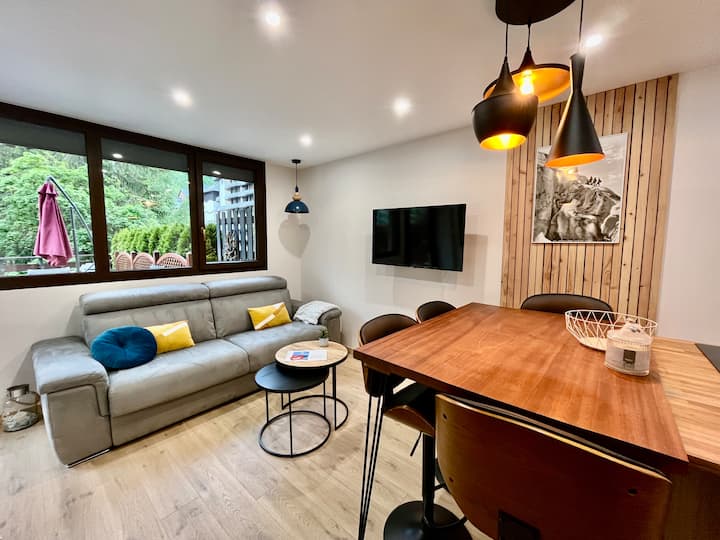
The location was perfect. We could walk into central Chamonix, to the Aiguille du Midi cable car, restaurants, bakeries and bars. For some hikes, we could simply walk out our front door and keep going until we were on trail. We were close to everything without being right in the middle of the busiest part of town, so our little area was surprisingly quiet.
Before the trip, I'd seriously considered staying in Les Praz, near the Flégère gondola. It's a very pretty area, extremely convenient for Flégère and Lac Blanc, and there's a beautiful roughly half-hour walk along the rushing river into central Chamonix. But I'm really glad we didn't stay there.
Les Praz feels distinctly separate from the center, and we loved being able to wander into Chamonix for dinner, wine, a pastry or just a walk without having to think about transportation. By the end of the trip, we strongly preferred anything we could reach directly on foot. We didn't mind adding easy walking miles; what we got tired of was another bus, train, timetable or connection.

If I were choosing again, I'd prioritize walkability to central Chamonix while staying just outside the busiest streets. And I'd absolutely want another great south-facing patio.
Planning a Hiking Trip to Chamonix
Getting around Chamonix is easy. Figuring out how everything fits together for hiking is surprisingly complicated.
For hikers, the lifts are essentially part of the trail system. I watched vlogs, read trail descriptions, studied maps and downloaded routes, but still struggled to get oriented from home. Take a gondola here, transfer to a cable car there, start hiking from one lift station and finish at another—and make sure that second lift is still running when you arrive.
Then there were the things maps couldn't really tell me: Which direction makes the most sense? What's the terrain actually like? Where are the exposed sections?
One Thing We Should Have Done Immediately
I'd seen this advice in Chamonix travel vlogs before our trip and somehow didn't follow it: go to the tourism office and talk to an actual human being.
The Chamonix-Mont-Blanc Tourist Office is right in town. If I were planning this trip again, I would go during the first day or two with my hiking wish list and ask questions that aren't always obvious from a map or an app. I'd also spend an hour simply getting geographically oriented. There are excellent large maps around Chamonix and at the major lift stations. Figure out where Brévent, Flégère, Les Bossons, Aiguille du Midi and Montenvers actually sit in relation to your lodging and to one another.
Once we were there, I relied heavily on routes I'd downloaded through AllTrails Chamonix, which was enormously helpful. But an app didn't replace understanding the valley. I still managed to take us in the wrong direction more than once—sometimes considerably in the wrong direction. Jason was remarkably patient.
Hiking in Chamonix
Petit Balcon Sud: Sometimes the Easier Day Is One of the Best

One of our most enjoyable hiking days was also one of the easiest: the Petit Balcon Sud. We could walk directly to the trail from our apartment. It was lightly traveled, moderate and enjoyable, and while the views weren't as dramatic as the high-Alpine trails, it was a great hike to start with.
Then we walked back toward town and stopped at Big Mountain Brewing Company for beers on the patio with fantastic mountain views. This became one of my favorite formulas of the trip: leave the apartment on foot, hike, walk home and stop somewhere wonderful along the way. Not every hiking day needs to be epic.
Brévent: Our First Taste of High-Alpine Hiking

From our rental we walked uphill to the Planpraz gondola, then continued by cable car all the way to Le Brévent. The views from the top were spectacular, but it was cold and windy, and almost immediately after we started hiking down I realized the trail was much rockier and more challenging than I'd pictured from my research.
This was our first high-Alpine hike of the trip, so I wasn't yet prepared for just how rocky these trails could be—or how much longer that terrain would take us. There were also a few exposed traverses that gave me pause, particularly with the wind and the possibility of weather moving in. We ultimately played it safe and turned around rather than continuing as far as we'd planned.
Knowing what I know now, I'd actually do this hike again—I'd just go into it with a much better understanding of the terrain, allow more time, and choose a calm-weather day. It was a spectacular introduction to hiking high above Chamonix; we just didn't quite know what we were getting ourselves into yet.
Lac Blanc: Yes, It's Crowded. Do It Anyway.

If I could recommend only one hike from this trip based purely on scenery, it would be Lac Blanc. Even in September, the trail was packed, but I didn't care. It was that beautiful.
We took the Flégère lift into the high country and had planned a loop returning via the Index side. But the trails were considerably rockier than we were accustomed to, and we weren't covering ground as quickly as expected. With the last lift down in mind, we played it safe and turned it into an out-and-back. Everything takes longer than you think it will in Chamonix.

When you reach Lac Blanc, leave time to explore rather than simply taking the classic photo and turning around. There are actually two lakes—an upper and lower lake—with small trails to wander, and the nearby Lacs des Chéserys are also worth exploring.
What I remember most, though, was the clouds. Much of the Mont Blanc massif was hidden when we arrived, and then the clouds began to break and the mountains slowly revealed themselves. I already love clouds, but there is something magical about the way they cling to these enormous peaks and constantly change the landscape.
Next time I'd start earlier, complete the loop we'd originally planned and leave more time around the lakes. Lac Blanc is insanely popular, but absolutely worth it.
Grand Balcon Sud: More Challenging Than I Expected

We also hiked the Grand Balcon Sud from Planpraz toward Flégère. "Balcony trail" sounded rather civilized to me. Apparently I had a different concept of balcony.
The views were spectacular, but once again the trail was rockier and more demanding than I'd pictured from my research. It was also busy, and we again found ourselves paying attention to the last lift down. Still, this is one I would absolutely recommend. I'd simply allow more time than we did.
Les Bossons: The Hike That Didn't Go According to Plan

We had originally hoped to attempt La Jonction, a famously strenuous hike with more than 4,000 feet of elevation gain. We were both a bit intimidated by that, so at the last minute we decided to aim for Le Chalet des Pyramides instead.
Then I took us in completely the wrong direction. I had Les Bossons planted in my head as being on the opposite side of Chamonix, and by the time we finally reached the Les Bossons chairlift, we no longer had time to reach Pyramides.
Instead, we took the wonderfully old-fashioned chairlift up, hiked to the Bossons Glacier viewpoint and climbed a bit farther before turning around. It wasn't the day we'd planned, but I loved that chairlift—and with hardly anyone using it, I wish we'd ridden it more than once.
This was another perfect example of why getting oriented early in the trip matters. I'd researched the hike itself; what cost us the hike was simply having the trailhead in the wrong place in my head.
A Note About Lift Passes
We had more than six days when we planned to use lifts and mountain trains, so we waited until some early bad weather passed before activating our six-day consecutive Mont Blanc MultiPass and paid separately for our Brévent day.
I later realized a seven-day pass would have suited our itinerary better and would also have covered our return from Montenvers. Before buying a pass, map out the lifts and mountain trains you expect to use—and factor in the weather.
Chamonix to Italy Over the Alps

What an incredible day this was! We took the Aiguille du Midi cable car from Chamonix and then boarded the Panoramic Mont-Blanc for the journey across the Alps to Italy.
And somehow, we had an entire gondola cabin to ourselves.
For the next stretch of the journey, it was just the two of us floating above glaciers, surrounded by some of the highest mountains in the Alps. It felt extraordinarily private and elevated, completely removed from normal life. I remember looking out at that landscape and thinking that this was one of the most spectacular experiences I'd ever had. Photographs don't really communicate the scale of it.

Eventually we arrived at Punta Helbronner on the Italian side, where we stopped for wine and a cheese plate at more than 11,000 feet. The food itself wasn't particularly memorable; drinking wine there absolutely was.
Then we descended into Italy aboard the rotating cable cars of Skyway Monte Bianco and eventually made our way into Courmayeur. This is the one part I'd plan differently. By then we were tired, and the roughly 45-minute walk into central Courmayeur wasn't particularly appealing. Next time I'd research one beautiful restaurant or patio in advance and go directly there rather than feeling like we needed to explore the town.
And then I'd make absolutely certain I booked the bus from Italy to France, because I did not. I accidentally booked our FlixBus from Courmayeur to Chamonix in the opposite direction.
We quickly learned that the correct bus was full, there were no Ubers or available taxis, and the Mont Blanc Tunnel was closing soon. Then the supposedly full bus arrived—and somehow there were exactly two seats left. I think we may have bribed the driver with all our remaining euro change...
It was a stressful ending to one of the most extraordinary days of my life, but that's not what I remember most. I remember the two of us alone in that little gondola, floating over the glaciers into Italy.
Staying Overnight at Montenvers: The Highlight I Almost Missed

Montenvers sits high above the Mer de Glace, the largest glacier in France, a vast river of ice surrounded by some of the most dramatic peaks of the Mont Blanc massif. You reach it from Chamonix on the little red Montenvers–Mer de Glace mountain train, which climbs from Chamonix to Montenvers in about 20 minutes.
I had been dreaming about seeing the Mer de Glace since coming across photos and videos while planning the trip. Seeing it in person was monumental. Even better, I discovered something I hadn't realized was possible: you can actually stay overnight up there.

We booked two nights at the historic Refuge du Montenvers and saved them for the end of the trip. Most visitors come up for the day to see the glacier and ice cave, perhaps hike, and then return to Chamonix. Staying overnight completely changes the experience. Once the final trains carry the day visitors away, the mountain becomes incredibly quiet.
We were also fortunate to get a corner room overlooking the Mer de Glace.
The view from that window was unlike anything I'd ever seen. I could have been completely happy never leaving the room.
Our original plan was to spend our full day hiking the Grand Balcon Nord, but with weather moving in, we did it on our arrival day instead. One of the highlights of that trail is the climb to Signal Forbes, a spectacular viewpoint high above Montenvers with sweeping views over the Mer de Glace and surrounding peaks.

Knowing what I know now, though, I wouldn't necessarily devote my full day at Montenvers to another big hike. I'd slow down and enjoy being there—visit the ice cave, ride the gondola, have some wine and watch the weather move across the glacier. But I would absolutely hike up to Signal Forbes, either early in the morning or later in the afternoon when the day visitors are gone.
That's one of the real gifts of sleeping at Montenvers: you can experience a spectacular section of the Grand Balcon Nord when the trail is nearly empty. On a trip where many of the famous trails were crowded, that's a pretty special opportunity.
The weather became part of the experience too. Clouds clung to the peaks, summits disappeared and reappeared, and the glacier moved in and out of the mist. I wouldn't have traded it for a perfectly clear blue sky.
Our stay included half board, which I'd choose again. Dinner was excellent, the wine and Champagne were wonderful, and at the end of the evening there was nowhere we needed to go. The glacier was right outside our window.
If this is the first time you've heard that you can sleep at Montenvers, put it on your list. Two nights was perfect for us.
Eating and Drinking in Chamonix
Food was easy in Chamonix, and we mostly kept it casual. One of the best things we did for hiking days was pick up baguette sandwiches in the morning. We often got them at Café Marie Blachère, near the Aiguille du Midi cable car. I'd brought small insulated lunch bags from home, so Jason would grab sandwiches, put them in his backpack, and we were set for the day. Simple, inexpensive and perfect for eating somewhere high in the Alps.
Our one planned dinner reservation was at Atmosphère, which was excellent. We also really liked Casa Nonna for the pizza and funky atmosphere; if I went back, I'd try to reserve the garden terrace. And one afternoon while Jason napped, I visited La Bottega MartaVini, a natural-wine bar I'd found while planning the trip, for pét-nat and small Italian dishes.

September was a nice time to balance a little planning with spontaneity. Having one dinner reservation saved us from decision fatigue after a long day, but otherwise we liked deciding as we went. In peak summer, I'd reserve anything I really cared about in advance.
I'd also throw a few extra snacks in the backpack; we had a remarkable talent for getting hungry during the afternoon hours when many restaurants were closed.
And despite neither of us speaking French, language was never an issue. Chamonix is such an international destination that we were able to communicate in English everywhere we needed to.
The Biggest Lesson: You're Going to Make Mistakes
Planning independent travel in Europe is hard, particularly when you're building a hiking trip around lifts, trains, buses, weather and trails in a place you've never been before. You can research obsessively—and believe me, I did—and you're still not going to get everything right.
I took us in the wrong direction more than once. I underestimated how long trails would take. And yes, I booked a bus in the wrong direction and very nearly stranded us in Italy.
At the time, some of those mistakes felt enormous. What's interesting is that Jason barely remembers them that way. When we talk about Chamonix, he remembers floating over glaciers into Italy, hiking through the Alps, drinking great wine and beer, and waking up at Montenvers.
And he's right. The mistakes weren't the trip. They were tiny pieces of a wonderful trip.
So do your homework, prepare well—and then be easy on yourself when something inevitably goes wrong. Figure it out, laugh about it when you can, and keep going.
You're going to remember the mountains, and the magic of it.
Comments